The 7-Second Window: How Missed Calls Hurt Restaurant Orders and Reservations
Missed calls are costing your restaurant more than you think. Learn how the 7-second window impacts orders, reservations, and guest experience, and how AI systems like Orderline solve it.
April 10, 2026
4 mins
The phone rings.
No one picks it up.
And in that short pause, something important happens — not inside your restaurant, but on the other end of the line.
The customer decides: “I’ll just order from somewhere else.”
There’s no complaint, no escalation, no alert. Just a quiet shift to the next option.
And what’s lost in that moment isn’t always just a phone order. It could have been a reservation, a catering inquiry, or a guest deciding whether to choose you at all.
For multi-outlet restaurant brands, this isn’t an occasional miss. It’s a recurring, invisible leak across locations.
This is exactly the gap Orderline AI is built to solve — not just by answering calls, but by structuring how they’re handled end-to-end.
That’s the 7-second window: where intent is high, patience is low, and uncertainty costs you.
Why the phone still matters
It’s easy to assume that the phone has become less relevant in a world of apps, delivery platforms, branded ordering websites, and digital menus. From the outside, it looks like restaurants have already moved on.
But operationally, that’s not quite true.
People don’t call restaurants casually anymore. They call because they’re ready to act or close to it.
That intent usually shows up as:
placing an order
making a reservation
asking something before deciding
And that last category is where most restaurants lose conversion.
Because the order comes after the answer. The reservation comes after the reassurance.
That’s why the phone isn’t just a support channel. It’s a decision channel.
And it’s a high-value one. According to Conversion Sciences, inbound calls can convert 10–15x higher than digital leads. By the time someone calls, they’re rarely browsing — they’re deciding.
Which makes missed or poorly handled calls far more expensive than they appear.
Where things start slipping
The issue isn’t effort. It’s structure.
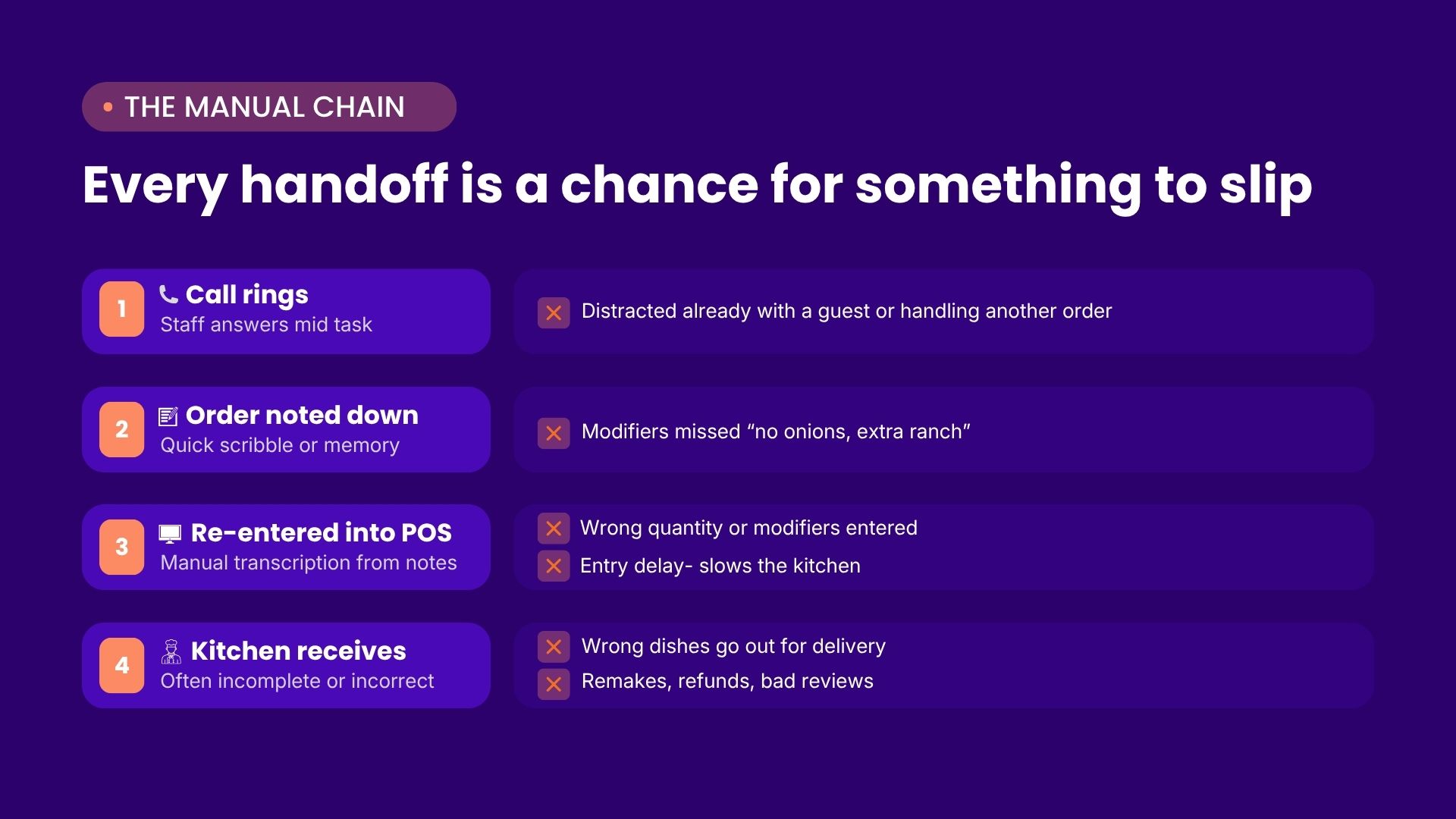
In a live restaurant, calls are answered mid-task — while serving a guest, coordinating with the kitchen, or handling delivery orders. The interaction starts under pressure and moves through a manual chain before becoming anything useful.
A typical call often looks like this:
answered while multitasking
details noted quickly or remembered
re-entered into the POS later
passed to the kitchen with delay
corrected only after something goes wrong
This is where things begin to slip.
Not because people aren’t capable, but because the process depends on everything going right in an environment where that’s unrealistic.
Here’s what that manual chain usually looks like behind the scenes:
Over time, this stops being occasional noise and becomes a pattern.
That’s when the phone stops being “just another task” and starts becoming a structural leak.
Why Orderline AI changes the equation
Most restaurants try to improve call handling by tightening the same process — better training, faster answering, fewer mistakes.
But the real shift comes from removing the dependency on manual handling altogether.
This isn’t just automation. It’s a system redesign.
Because restaurants aren’t just managing order calls
One of the biggest reasons the phone remains so poorly managed is because many restaurants still think of inbound call volume as one thing.
In reality, it’s usually three very different workflows happening through the same channel.
And that distinction matters, because solving only one of them still leaves most of the friction in place.
1. Concierge
A large share of inbound calls are simply guests trying to get clarity before they act.
That includes things like:
menu and dietary questions
store timings and directions
catering or event inquiries
issue resolution and complaints
routing to the right team
These interactions may not always look like direct revenue, but they shape whether a guest converts, returns, or trusts the brand at all.
This is where Orderline AI acts as a first layer of customer handling, helping restaurants respond more consistently to the kinds of questions that would otherwise interrupt service or disappear into the cracks.
2. Orders
This is the most obvious revenue layer, and often the one restaurants focus on first.
When a customer calls to order, intent is already high. But without structure, that interaction still creates room for friction:
missed modifiers
manual note-taking
re-entry into the POS
order errors under pressure
This is where Orderline AI helps bring speed and precision into the order flow, so high-intent demand doesn’t get diluted by operational mess.
3. Reservations
Reservation-related calls often arrive at the worst possible time — right in the middle of service.
And yet they still need timely handling.
Whether it’s:
a booking request
an availability check
a reservation confirmation
or a guest trying to plan before they visit
…these interactions carry real revenue value and can’t afford to get buried in front-of-house overload.
This is where Orderline AI helps ensure that bookings don’t compete with service.
Taken together, that’s what makes the phone such an important business layer. It isn’t one use case. It’s multiple high-intent workflows competing for attention through the same channel.
Trying to handle all three through the same manual flow is where most of the friction begins.
Orderline AI works because it doesn’t just solve for orders — it structures all three.
Why consistency matters more than speed
Speed matters, of course.
But for multi-outlet brands, consistency is often the bigger challenge.
A restaurant can survive the occasional delayed answer.
What becomes much harder to manage is when the customer experience changes based on:
which location they called
which shift is running
who picked up the phone
how experienced that person is
or how chaotic the restaurant happens to be in that moment
That’s where brands start losing control of the experience.
And the issue is not always dramatic. It shows up quietly:
one location captures modifiers well, another doesn’t
one team handles bookings cleanly, another fumbles them during rush
one store escalates complaints properly, another lets them disappear
one outlet sounds organized, another sounds overwhelmed
Over time, those differences stop feeling like operational quirks.
They become part of the brand.
That’s why consistency matters so much at scale. Restaurants spend significant effort standardizing menus, kitchen execution, delivery workflows, pricing, and reporting — but the phone often remains dependent on human variability.
And that is exactly where quality starts to drift.
Because at scale, quality can’t depend on who happened to pick up:
That’s one of the most meaningful things Orderline AI helps solve.
Not just whether the call gets answered, but whether the experience holds its quality — across locations, across shifts, and across the different kinds of calls restaurants receive every day.
And once that happens, the value becomes much easier to see.
The shift that actually matters
At first glance, this may look like a story about answering more calls. It isn’t.
It’s a story about removing uncertainty from one of the highest-intent parts of the customer journey.
The shift that matters is not:
“AI answers the phone.”
It’s:
“Orders, reservations, and guest conversations are handled reliably, even when the restaurant is under pressure.”
That is a much more meaningful operational outcome.
Because once that happens, restaurants stop depending on perfect timing and staff availability to protect demand. And when that dependency is removed, the business becomes more resilient.
Not because people are working harder. Because the system is finally doing more of the work it should have been doing all along.
That’s the real promise of a product like Orderline AI. Not just automation.
But dependability at scale.
Closing thought
A missed call is rarely just a missed call.
It might be:
a lost order
a missed reservation
an unanswered question
a catering lead that never got captured
or a guest who quietly chose someone else
That’s what makes the 7-second window so expensive.
It’s not loud. It doesn’t announce itself. It simply drains value in small, repeated ways that most restaurants never fully see. Fixing that doesn’t start with asking your team to “stay more on top of calls.”
It starts with designing a better system for handling the customer intent that is already showing up every day.
And for multi-outlet restaurant brands, that kind of consistency is not just useful. It’s infrastructure.
If calls are still creating friction across your orders, reservations, and guest support, it may be time to stop treating the phone like an operational side task — and start treating it like the customer journey layer it already is. Book a demo and explore Orderline AI to see how it fits into your setup.
Did you know that Uber Eats serves over 88 million hungry customers worldwide? With online ordering booming, making your restaurant stand out on Uber Eats is a golden opportunity. If you're ready to boost your orders and reach new customers, our blog will walk you through the top Uber Eats marketing strategies to get you there.
Did you know that a mere one-star increase in your restaurant’s rating can spike your revenue by 5-9%? That's right, according to Harvard Business School, those stars do translate into dollars. It's all about strategy and a pinch of magic in customer service.
In the bustling world of the restaurant industry, where enticing dishes and impeccable service are paramount, the design and structure of your menu can often be an overlooked goldmine. Dive into the world of menu engineering, where art meets science, and discover how subtle tweaks to your restaurant menu can lead to significant boosts in profits.


.jpg)
.jpg)
.jpg)

.webp)

.webp)


